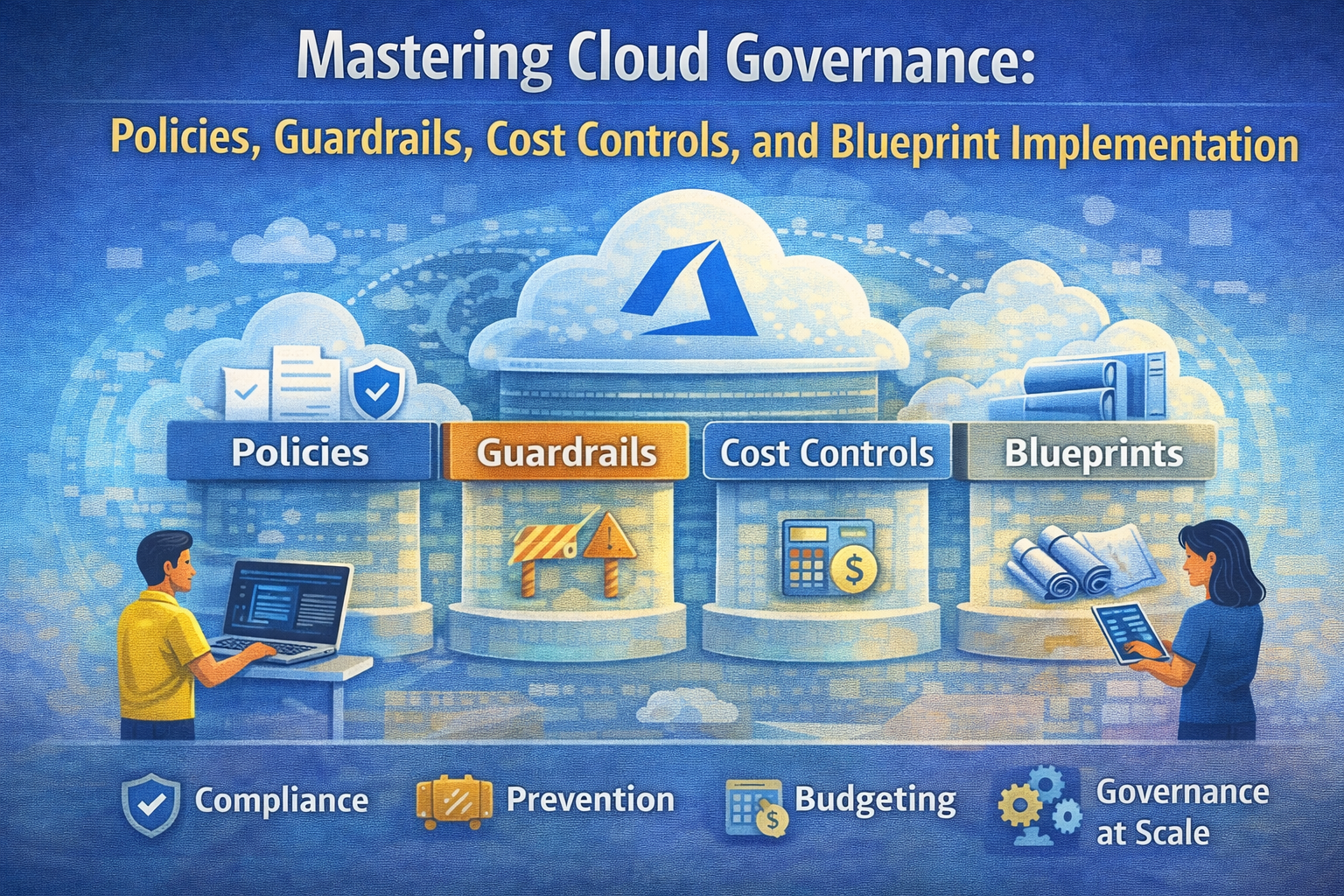
Mastering Cloud Governance: Policies, Guardrails, Cost Controls, and Blueprint Implementation
Cloud governance is the strategic foundation that ensures organizations realize the benefits of cloud computing while mitigating risks and managing costs effectively. As enterprises accelerate their cloud adoption, developing a robust governance framework becomes essential to enforce standards, maintain security, comply with regulations, and optimize cloud spend.
This article dives deep into the critical components of cloud governance — including policies, guardrails, cost controls, and blueprint implementation — and provides practical guidance and best practices for intermediate to advanced cloud professionals.
Understanding Cloud Governance
Cloud governance defines the rules, roles, and processes that guide cloud usage within an organization. It ensures that cloud environments are secure, compliant, cost-efficient, and aligned with business objectives.
Key pillars of cloud governance include:
- Policies: Formal rules that dictate how cloud resources should be used and managed.
- Guardrails: Automated controls and boundaries that enforce policies and prevent risky actions.
- Cost Controls: Mechanisms to monitor, budget, and optimize cloud spending.
- Blueprints: Predefined architectural templates that enforce best practices and compliance from the start.
Together, these elements create a framework that balances agility with control.
1. Crafting Effective Cloud Governance Policies
Policies form the backbone of cloud governance by explicitly defining what is allowed and what is not. Creating clear, enforceable policies helps mitigate risks such as security breaches, regulatory violations, and uncontrolled costs.
Best Practices for Policy Development
-
Standardize Policy Format and Language: Use a consistent template with elements such as Policy ID, Category, Statement, Scope, Purpose, and Remediation. Employ clear, authoritative language using terms like “must” and “must not” to avoid ambiguity.
-
Policy Identification: Assign unique identifiers (e.g., SC01 for Security Policy #1) to easily reference and track policies.
-
Link Policies to Risks: Every policy should directly address an identified risk, ensuring focused and relevant governance.
-
Categorize Policies: Organize policies into categories such as Security, Compliance, Cost Management, Operations, Data, Resource Management, and AI to facilitate navigation and enforcement.
-
Define Scope and Exceptions: Clearly specify the resources, teams, regions, or workloads to which the policy applies, including any exceptions.
-
Remediation Strategies: Outline steps to take when a policy violation occurs, tailoring responses based on risk severity. For instance, nonproduction violations might trigger scheduled reviews, while production violations require immediate action.
Sample Cloud Governance Policy Template
Policy ID: SC01
Category: Security
Risk ID: R02
Statement: Multifactor authentication (MFA) must be enabled for all users accessing cloud resources.
Purpose: To mitigate unauthorized access and data breaches.
Scope: Applies to all Azure Active Directory users.
Remediation: Immediate revocation of access for noncompliant users.
Monitoring: Enforced via Microsoft Entra ID Conditional Access policies.
Example Policies in Practice
| Policy ID | Category | Statement | Purpose | Scope | Remediation | Monitoring |
|---|---|---|---|---|---|---|
| SC01 | Security | MFA must be enabled for all users. | Prevent unauthorized access. | Azure users | Revoke access immediately. | Microsoft Entra ID |
| CM01 | Cost Management | Budget alerts must be set at resource group level. | Control cloud spending. | Workload teams | Immediate review on alerts. | Microsoft Cost Management |
| RM02 | Resource Management | Tags must be enforced on all cloud resources. | Enable resource tracking. | All cloud resources | Correct tagging within 30 days. | Azure Policy |
2. Establishing Guardrails to Enforce Policies
Guardrails are automated controls that prevent or detect noncompliance with governance policies. They act as safety nets, ensuring that cloud users and teams operate within predefined boundaries.
Types of Guardrails
- Preventive: Block undesired actions before they occur, such as denying deployment of resources in unauthorized regions.
- Detective: Identify and alert on policy violations post-deployment for manual remediation.
- Corrective: Automatically remediate violations, such as tagging untagged resources or shutting down noncompliant workloads.
Implementing Guardrails with Azure Policy
Azure Policy is a powerful service to create, assign, and manage policies that enforce rules across Azure resources. Features include:
- Definition of policy rules using JSON.
- Assignment to specific scopes (management groups, subscriptions, resource groups).
- Remediation tasks to fix noncompliant resources.
- Integration with Azure Blueprints for environment setup.
Example: Enforcing resource tagging
{
  "if": {
    "field": "tags",
    "exists": false
  },
  "then": {
    "effect": "modify",
    "details": {
      "roleDefinitionIds": ["<role-id>"],
      "operations": [
        {
          "operation": "add",
          "field": "tags.Department",
          "value": "Unknown"
        }
      ]
    }
  }
}
This policy automatically adds a “Department” tag with the value “Unknown” if a resource is deployed without tags.
3. Implementing Cost Controls to Optimize Cloud Spend
Uncontrolled cloud costs can quickly spiral out of control without governance. Cost controls ensure spending aligns with budgets and business priorities.
Practical Cost Management Strategies
-
Set Budgets and Alerts: Define budgets at granular levels (resource groups, subscriptions) and configure alerts to notify stakeholders of threshold breaches.
-
Regular Cost Reviews: Utilize tools like Azure Cost Management and Azure Advisor to analyze spending patterns and receive optimization recommendations.
-
Tagging for Cost Allocation: Enforce tagging policies to attribute costs to teams, projects, or environments for accurate chargeback and budgeting.
-
Use Reserved Instances and Savings Plans: Commit to reserved resources where appropriate to lower costs.
-
Automate Shutdown of Noncritical Resources: Schedule power off for development or test environments during off-hours.
Example Cost Policy
Policy ID: CM01
Category: Cost Management
Risk ID: R04
Statement: Workload teams must set budget alerts at the resource group level.
Purpose: Prevent overspending and enable proactive cost management.
Scope: All workload teams and platform teams.
Remediation: Immediate budget review and adjustment upon alert.
Monitoring: Azure Cost Management alerts.
4. Leveraging Blueprints for Consistent Cloud Environments
Blueprints are composable packages of governance artifacts that enable consistent deployment of compliant cloud environments.
Benefits of Using Blueprints
- Repeatability: Deploy standardized environments quickly.
- Compliance: Embed policies, role assignments, and resource templates into a single package.
- Simplified Management: Update blueprints centrally to propagate governance changes.
Typical Blueprint Components
- ARM Templates/Bicep files: Define infrastructure-as-code for resource provisioning.
- Policy Assignments: Enforce guardrails during deployment.
- Role Assignments: Ensure least privilege access control.
Example Use Case
An organization requires every new subscription to have:
- Enforced tagging policies.
- Budget alerts configured.
- Security policies like mandatory MFA.
- Network security groups with predefined rules.
A blueprint bundles these components, enabling subscription owners to provision compliant environments with minimal manual configuration.
5. Continuous Review and Improvement of Governance
Cloud governance is not a set-and-forget activity. Continuous assessment ensures policies and controls evolve with changing business needs, technology, and compliance landscapes.
Review Strategies
- Event-Based Reviews: Trigger updates after significant incidents, technology changes, or regulatory updates.
- Scheduled Reviews: Regularly revisit policies and guardrails—quarterly or biannually.
- Feedback Mechanisms: Collect input from users and stakeholders to identify pain points or inefficiencies.
- Change Control Processes: Implement formal procedures for updating governance artifacts to maintain traceability and accountability.
Identifying Inefficiencies
Example: If multiple workloads independently deploy web application firewalls, governance can be updated to mandate a centralized firewall, reducing duplicated effort and costs.
Real-World Scenario: Implementing Governance in a Multi-Subscription Azure Environment
Context
An enterprise operates multiple Azure subscriptions across regions supporting development, testing, and production.
Steps Taken
-
Risk Assessment: Identified risks such as unauthorized access, data leakage, and cost overruns.
-
Policy Creation: Developed policies like:
- MFA enforcement (SC01).
- Tagging enforcement (RM02).
- Budget alerts (CM01).
-
Guardrails Deployment: Used Azure Policy to enforce tagging and MFA.
-
Blueprints: Created blueprints to provision new subscriptions with necessary policies, role assignments, and resource templates.
-
Cost Management: Set budgets per subscription with alerts and reviewed Azure Advisor recommendations monthly.
-
Continuous Review: Held quarterly governance meetings to review incidents, feedback, and update policies.
Outcome
The enterprise achieved improved security posture, cost visibility, and streamlined cloud operations with clear accountability.
Conclusion
Effective cloud governance is vital for secure, compliant, and cost-efficient cloud adoption. By systematically developing clear policies, implementing automated guardrails, controlling costs, and leveraging blueprints, organizations can empower teams to innovate confidently while maintaining control.
Remember to treat cloud governance as an evolving discipline — continuously review and refine policies and guardrails to adapt to new challenges and opportunities.
Further Reading
Author: Joseph Perez